
CEI in Bacău County: institutional responses
Responses received by FEW on the use of the electronic identity card in Bacău County, compiled in an anonymised PDF together with a summary of the Foundation’s initiative.
Romanian original
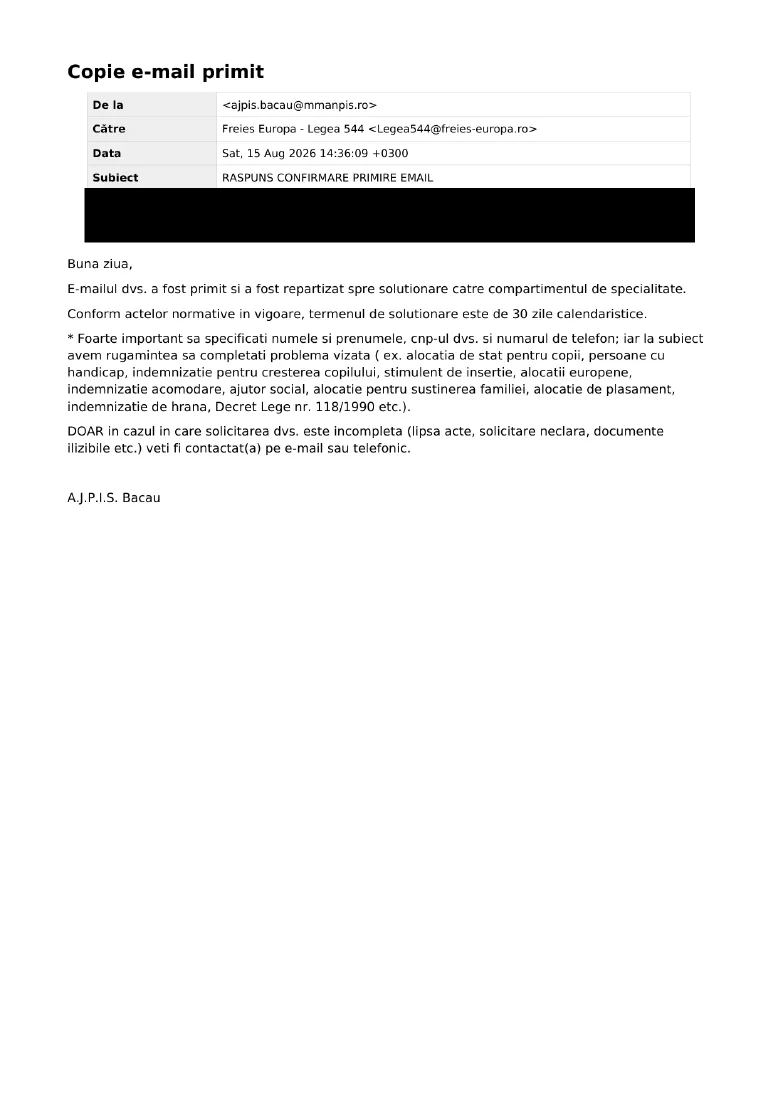
What the document contains
Summary of the institutions’ responses
The responses received in August–September 2026 describe different practices in the use of the electronic identity card (CEI) in the institutions covered by this case file.
Bacău County Agency for Payments and Social Inspection reports one working reader. Moinești reports six readers in the institution, including one in the Revenue Service, and Bacău Office for Cadastre and Land Registration confirms the existence of working equipment. These responses do not provide separate statistics on CEI use.
The mayor’s office and local tax department in Slănic-Moldova, and the tax department in Târgu Ocna, state that they have no readers but use alternative ways of verifying domicile and have not requested separate certificates because of the CEI. The County Pension House reports having no readers or separate statistics, but states that it does not make the processing of applications conditional on additional proof of domicile.
Bacău Inspectorate for Emergency Situations accepts the CEI for identification, without checking domicile in the operations described. The County Statistics Directorate uses identity data in personnel administration, without readers or separate statistics by type of document. The absence of statistics does not mean zero uses. Târgu Ocna Prison Hospital reports zero healthcare validations using the CEI, explaining this by the particular features of the prison system.
Summary of FEW’s initiative
FEW requested information on actual use of the electronic identity card, not just on equipment. The requests covered procedures, verification of domicile, data exchange between institutions, acceptance of electronically signed documents, difficulties encountered by holders and remedial measures. For tax administrations, the questions included updates to taxpayers’ addresses and records. For insurance houses and hospitals, they addressed separately the validation of healthcare services using the CEI, errors and the instructions applied.
The aim was to document use of the identity document without unnecessary travel or additional documents. A valid CEI is an identity document, and domicile is recorded electronically, under OUG No. 97/2005, Article 12(3), Article 13(1) and Article 17(5³). Direct retrieval of data needed for the public service, at the beneficiary’s express request or with their express consent, is governed by OUG No. 41/2016, Article 4. Documents signed using the advanced signature certificate issued by MAI have the same legal effect as documents signed by hand, under Article 17¹(1¹) of OUG No. 97/2005.
The initiative also relates to the national commitments in the PNRR: 2.1 million CEI cards and 11 online public services accessible using the CEI, set out in Component 7, Investment 8, milestones 173–174. These benchmarks explain the interest in the difference between issuing the document and its actual use when dealing with institutions.
The pages of the copy correspond one to one to the source pages.
File details
- Institutions
- Institutions in Bacău County
- File
- cei-bacau-raspunsuri-institutii-2026.pdf
- Format and size
- PDF · 58 pages · 29.4 MB
- SHA-256
30abbed960f40656a1eb127e9a6d0757d7d1bb28c8d2dabfce1a29860f28d9ca
Republishing: consult the rules and the terms governing the document.