
CEI in Suceava County: institutional responses
Responses received by FEW on the use of the electronic identity card in Suceava County, compiled in an anonymised PDF together with a summary of the Foundation’s initiative.
Romanian original
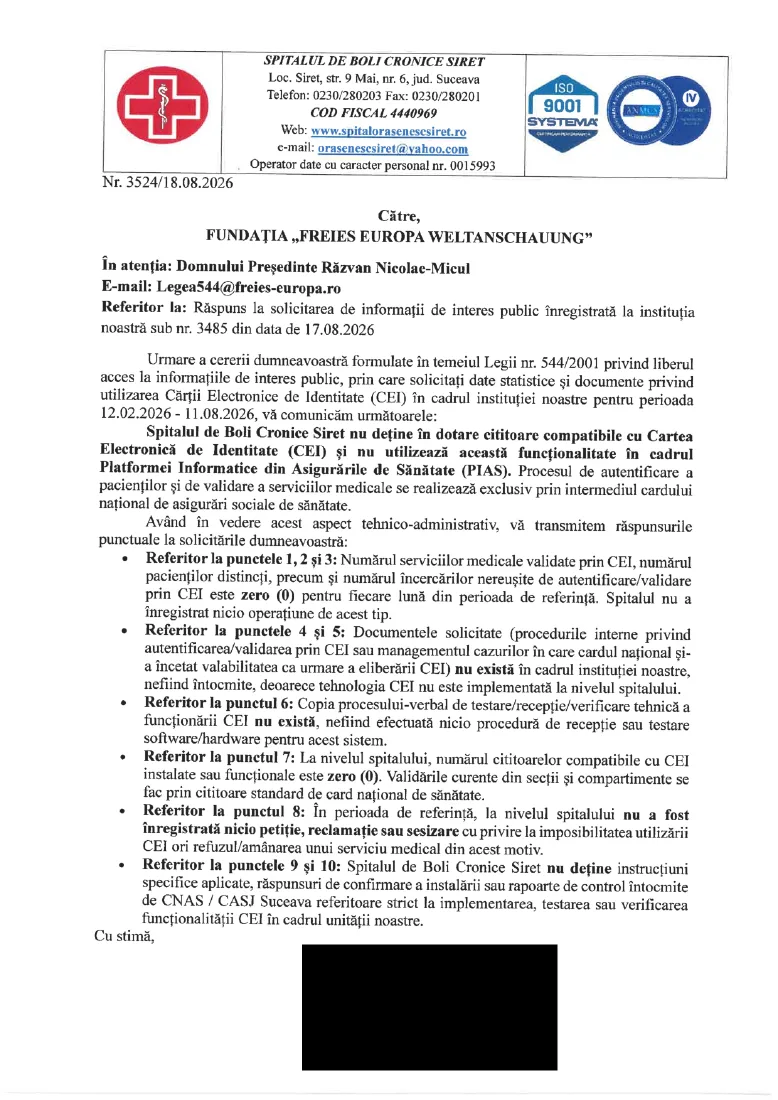
What the document contains
Summary of the institutions’ responses
In healthcare, the responses distinguish equipment provision from actual use. For 12 February–11 August 2026, Siret Hospital for Chronic Diseases reports zero validations using the electronic identity card (CEI) and no compatible readers. Câmpulung Moldovenesc Psychiatric Hospital reports six points equipped with working readers, but no services validated using the CEI, with testing stopping before validation in the insurance system. Suceava Health Insurance House provides a general explanation of technical preparations and announces use of the CEI for validation from 1 September, without the detailed statistics requested. The announcement does not prove subsequent activation.
In local administration, Broșteni reports seven working readers and daily readings, Vatra Dornei six readers, Rădăuți four, Vicovu de Sus three, and Milișăuți one. The equipment is not accompanied by comparable statistics or, in several cases, dedicated procedures. Frasin describes mechanisms not yet brought into operation. Solca has no reader in its tax department and identifies the certificate issued by the local population records service as a means of proving domicile.
The County Agency for Payments and Social Inspection (AJPIS) and the driving licence and vehicle registration service, through the prefecture’s response, describe checking domicile in the National Population Register without requesting separate proof. AJPIS cannot, however, quantify CEI use separately. The County Population Records Directorate presents arrangements for providing data on individual requests, without a complete inventory of institutional access. The Office for Cadastre and Land Registration also sends instructions on CEI use.
At regional level, Nord Gaz states that it accepts the CEI on visual inspection, without additional certificates of domicile.
Summary of FEW’s initiative
FEW examined whether CEI holders can have their applications dealt with without travel or additional documents required solely because the document cannot be read. The requests concern procedures, working readers, verification of domicile, updating tax records, electronic documents, incidents and remedial measures. Hospitals and CAS were asked separately for data on healthcare validations. The County Population Records Directorate was asked for information on institutions’ access to data, including alternatives to interconnection of information systems. The requests distinguish non-existent indicators from zero values.
Access to this information is based on Law No. 544/2001, Article 6(1). The status of the CEI as an identity document and the electronic recording of domicile are distinct considerations, under OUG No. 97/2005, Article 12(3), Article 13(1) and Article 17(5³)(f). OUG No. 41/2016, Article 4(1), provides for direct retrieval of data at the beneficiary’s request or with their express consent. The connection with the PNRR annex revised in 2026, Component 7, Investment 8, milestones 173–174, concerns the transition from issuing documents to using them for public services. These national commitments do not amount to an obligation to implement all CEI functions at every counter.
The pages of the copy correspond one to one to the source pages.
File details
- Institutions
- Institutions in Suceava County
- File
- cei-suceava-raspunsuri-institutii-2026.pdf
- Format and size
- PDF · 79 pages · 43.4 MB
- SHA-256
9e1995279b88cdfe25a30937af1f6cf4259219f3723f68b9f5cd4fd184a76faa
Republishing: consult the rules and the terms governing the document.