
CEI in Tulcea County: institutional responses
Responses received by FEW on the use of the electronic identity card in Tulcea County, compiled in an anonymised PDF together with a summary of the Foundation’s initiative.
Romanian original
What the document contains
Summary of the institutions’ responses
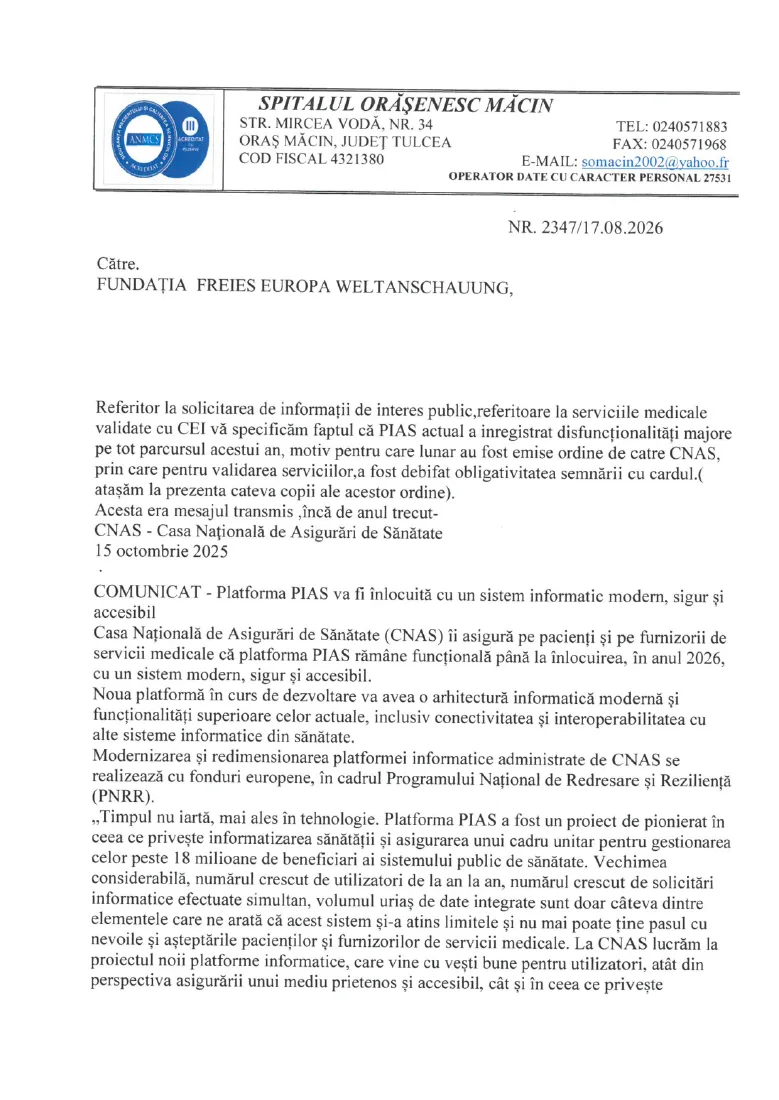
The responses from Tulcea, received in August and September 2026, describe both equipment in use and functionalities being prepared. The Health Insurance House describes integration of the electronic identity card (CEI) into the Health Insurance Information Platform as undergoing testing and gives 1 September 2026 as the planned date. This communication does not prove subsequent actual operation. Măcin Town Hospital explains the platform’s difficulties and sends documents on service validation during downtime, without providing the quantitative indicators requested concerning the CEI.
The tax service of Tulcea Municipality reports four readers and states that it has not requested separate proof of domicile from CEI holders. The County Agency for Payments and Social Inspection reports one working reader and sends the acceptance report. It states, however, that it cannot compile a central record of interactions and that the device does not record readings. The existence of equipment therefore does not provide usage statistics.
Isaccea describes the absence of readers, acceptance of certificates of domicile and support from the population records service in the same building. The County Pension House states that it accepts the CEI for identification and uses other methods of verifying the address, without readers of its own. The County Population Records Service reports issuing certificates of domicile for 374 citizens, without data from the other local services.
In its response to FEW’s complaint, the County Statistics Directorate clarifies acceptance of the CEI, the absence of equipment and the absence of separate indicators. The Inspectorate for Emergency Situations states that, for the operations described, it uses the CEI for identification without checking domicile.
The twenty readers mentioned by the Galați Regional General Directorate of Public Finance are regional data, not equipment exclusively in Tulcea.
Summary of FEW’s initiative
FEW asked institutions in Tulcea to explain acceptance of the CEI, verification of domicile and any additional documents required. The requests cover actual readings, access to registers, postponements, complaints and remedial measures. The prefecture was asked for information on driving licences, vehicle registration and coordination of institutions, and the county population records service on data exchange and certificates issued. In healthcare, the questions concern healthcare validations and the procedures applied, not just reader equipment.
Access to this information is based on Law No. 544/2001, Article 6. Proof of identity and the electronic recording of domicile are governed separately by OUG No. 97/2005, Article 13(1) and Article 17(5³). FEW therefore also examines direct retrieval of the data needed for the public service, at the beneficiary’s request or with their express consent, under OUG No. 41/2016, Article 4(1).
The initiative places local use in the context of the National Recovery and Resilience Plan (PNRR), C7/I8, milestones 173–174: issuing 2.1 million CEI cards and access to 11 online public services using the CEI. These commitments do not mean that every institution in Tulcea must provide all CEI functions.
The pages of the copy correspond one to one to the source pages.
File details
- Institutions
- Institutions in Tulcea County
- File
- cei-tulcea-raspunsuri-institutii-2026.pdf
- Format and size
- PDF · 61 pages · 26.1 MB
- SHA-256
28fc6ffbbad4c8190f8f3bbcf23db9afb400cc045c990384a7f1179ac0e776b4
Republishing: consult the rules and the terms governing the document.