
CEI in Sălaj County: institutional responses
Responses received by FEW on the use of the electronic identity card in Sălaj County, compiled in an anonymised PDF together with a summary of the Foundation’s initiative.
Romanian original
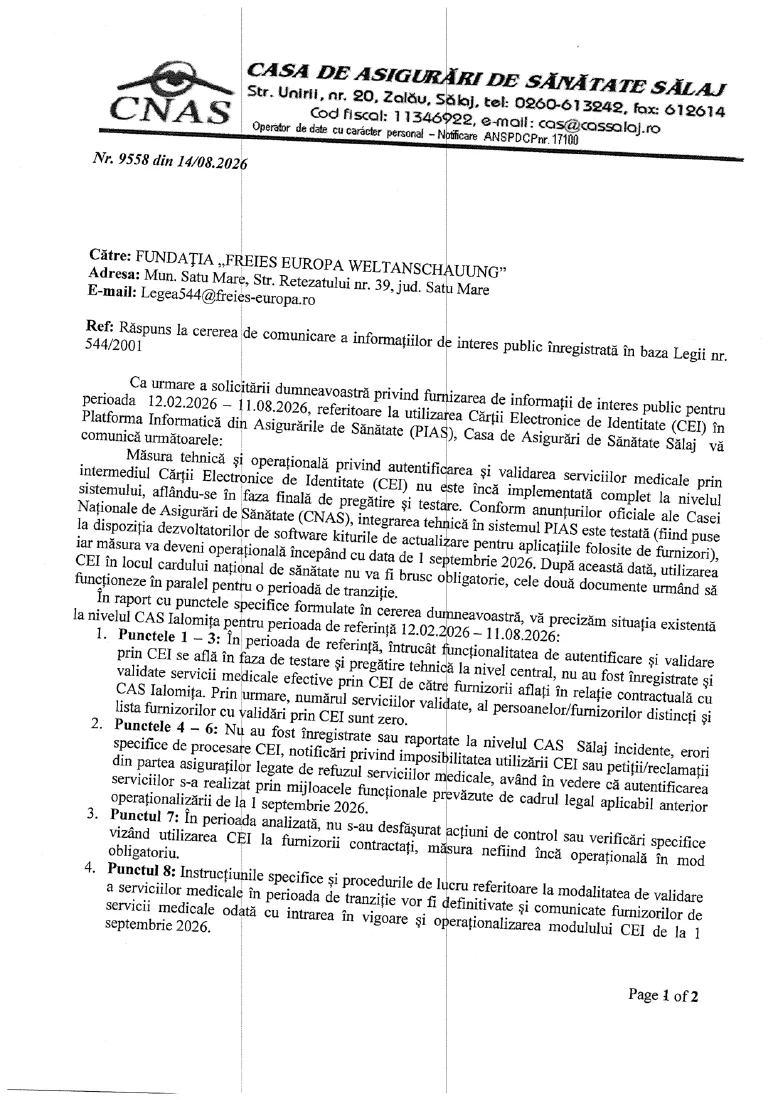
What the document contains
Summary of the institutions’ responses
In healthcare, the responses describe technical limitations on use of the electronic identity card (CEI), not general refusals to accept the document. Crasna Hospital for Chronic Diseases reports zero validations using the CEI for 12 February–11 August 2026 and no compatible readers. Jibou Town Hospital likewise states that it has no such equipment and has received no instructions for service validation. In August, CAS Sălaj announced that validation using the CEI would be possible from 1 September 2026. The announcement does not confirm subsequent operation.
In administration, Jibou Mayor’s Office reports purchasing readers for all offices, while Cehu Silvaniei Mayor’s Office reports using working equipment without requesting additional paper proof of domicile. Șimleu Silvaniei describes using the RoCEIReader mobile application and available records, although it has no dedicated readers. The employment agency, AJOFM, reports five working readers, and the Cadastre Office confirms equipment for reading the CEI. The prefecture reports verifying domicile through the National Population Register. This equipment provision is not accompanied everywhere by separate usage statistics.
The social payments agency, AJPIS, reports having no readers and no separate records for several indicators.
The regional response from the Cluj-Napoca Regional General Directorate of Public Finance describes data exchange with the population records service and the absence of readers within the directorate.
Summary of FEW’s initiative
For Sălaj, FEW requested information distinguishing acceptance of the CEI, reading domicile data and electronic use of services. The requests concern information on actual transactions, working readers, procedures, additional evidence required from holders, postponements, complaints and inspections. The questions to the prefecture also concern coordination of institutions, while the healthcare questions distinguish healthcare validation from mere identification. The requests explicitly ask that the absence of statistics should not be reported as zero.
A valid CEI proves identity, while the electronically recorded address requires a separate means of verification, under OUG No. 97/2005, Article 12(3), Article 13(1) and Article 17(5³). Under OUG No. 41/2016, Article 4(1), the data needed for a public service are retrieved directly from the institution holding them, at the beneficiary’s express request or with their express consent. The initiative therefore examines who obtains proof of domicile and whether holders are sent unnecessarily from one institution to another.
The reference to the National Recovery and Resilience Plan (PNRR) concerns Component 7, Investment 8: the issue of CEI cards and 11 online public services accessible using the CEI, according to the revised PNRR annex, milestones 173–174, pp. 107–108. These commitments do not, in themselves, oblige every service counter to provide all the document’s functions. The responses describe institutional practices, not the outcome of the European assessment of the milestones.
The pages of the copy correspond one to one to the source pages.
File details
- Institutions
- Institutions in Sălaj County
- File
- cei-salaj-raspunsuri-institutii-2026.pdf
- Format and size
- PDF · 87 pages · 53.5 MB
- SHA-256
6f3d728a05828ac8769a67b91f5ee40dc56ce571bdfec74f8cf360bed6146412
Republishing: consult the rules and the terms governing the document.