
CEI in Satu Mare County: institutional responses
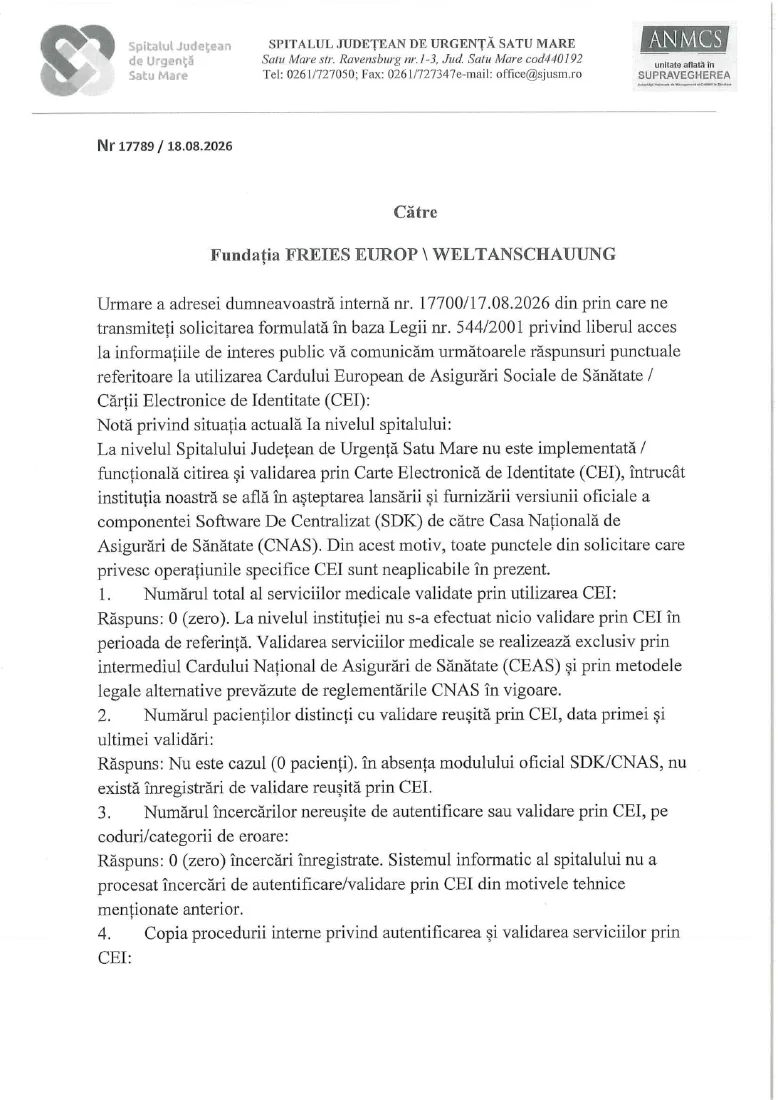
Responses received by FEW on the use of the electronic identity card in Satu Mare County, compiled in an anonymised PDF together with a summary of the Foundation’s initiative.
Romanian original
What the document contains
Summary of the institutions’ responses
For the period 12 February–11 August 2026, Satu Mare County Emergency Hospital, the Hospital for Respiratory Diseases and Tuberculosis and Negrești-Oaș Town Hospital state that they did not validate healthcare services using the electronic identity card (CEI). In Negrești-Oaș, the 42 compatible readers installed in 35 locations did not also mean that the CEI was integrated into the healthcare application. The hospital states that patients received services through other validation methods. The County Hospital upheld FEW’s administrative complaint and supplemented its response on 1 September 2026, confirming the absence of CEI validations, procedures and testing.
The mayor’s offices in Livada, Ardud and Tășnad report working readers. The tax service in Negrești-Oaș sent a response and a procedure for checking and updating data. The social payments agency, AJPIS, states that it has two working readers but requests additional proof of domicile for applications by email. The Public Domain Administration’s parking procedure also distinguishes reading at the counter from the requirement for scanned proof for online applications. The prefecture describes verification of domicile through the National Population Register. The existence of equipment therefore does not, on its own, describe the holder’s experience.
The documents from Oradea CF Clinical Hospital, the Cluj-Napoca Regional General Directorate of Public Finance and the energy operators have regional coverage, not coverage exclusively of Satu Mare. The tax directorate reports updating data through the ANAF–DGEP protocol. CPL Concordia states that it accepts the CEI but maintains that some obligations invoked by FEW do not apply to it.
Summary of FEW’s initiative
In Satu Mare, FEW examined whether the CEI can actually be used, not merely formally accepted. It requested procedures and information on transactions, equipment, additional proof of domicile required from holders, incidents and inspections. For healthcare, it distinguished service validation from patient identification. For taxation, it asked about updating data and transferring records. The requests are based on the right to public information under Law No. 544/2001, Article 6(1).
The distinction matters because a valid CEI is an identity document and domicile is recorded electronically. Recognition of the document and the ability to read its data are different matters, under OUG No. 97/2005, Article 12(3), Article 13(1) and Article 17(5³). The initiative therefore examines how the holder obtains the service, not just the inventory of readers.
The National Recovery and Resilience Plan (PNRR), Component 7, Investment 8, includes issuing 2,100,000 CEI cards and 11 online public services accessible using the CEI, according to the revised PNRR annex, milestones 173–174, pp. 107–108. These national commitments provide the context for the assessment but must not be confused with each institution’s specific obligations.
The pages of the copy correspond one to one to the source pages.
File details
- Institutions
- Institutions in Satu Mare County
- File
- cei-satu-mare-raspunsuri-institutii-2026.pdf
- Format and size
- PDF · 98 pages · 46.3 MB
- SHA-256
dc96fe10daea7cce25e1df80a9626303189305edc035d80df440ed4227d0fc43
Republishing: consult the rules and the terms governing the document.